Pool leak detection in Austin, TX from Blue Science: pressure and dye testing that finds where an Austin swimming pool is losing water, even when hard Hill Country water, cedar pollen, and 100-degree summers make evaporation hard to judge, a written report with the location and the results explained, the leak repair quoted separately, and a 30-day warranty when we do the repair. Pricing varies by pool, so call for a quote on the standard leak detection visit.
Austin, TX Pool Leak Detection
Stop guessing where the water is going
We follow the evidence, pressure testing, dye testing, and focused inspection, then explain what we found on your Austin pool and the practical next step.
Pool Leak Detection for Austin
Water loss has a source; find it before it becomes a bigger problem
Austin sits on karst limestone west of I-35 and blackland clay east of it, and a leaking pool behaves differently on each: rock swallows the water without a sign, and clay moves the shell every season. If your pool is losing more than evaporation explains, Blue Science finds the source and quotes the repair separately.
On limestone there is rarely a wet patch to point at, and on clay the wet patch is often nowhere near the leak. We rely on pressure and dye testing rather than looking for water, and we show you the findings before proposing a repair.
Leak clues in an Austin pool
 From the leak crew
Air in the pump basket, a level that drops faster with the pump running, a deck joint that has opened on a slope, a downhill wet spot, or a jump in the water bill are the signs worth a call. The bucket test below separates summer evaporation from a real leak in a day.
Return lines routed around rock in Northwest Hills, root-bound original plumbing in Tarrytown, and clay-stressed fittings east of I-35 are the usual sources, and each is dye-tested during the visit.
Leak detection across Austin
 From the leak crew
Our leak technicians cover Austin on the same schedule as our weekly routes through Tarrytown, Northwest Hills, Steiner Ranch, and Circle C, so a visit can be arranged quickly. Call for pricing on the standard leak detection visit, and repairs are quoted separately once the source is found.
Detection carries a 30-day warranty when Blue Science performs the repair, and the line is retested afterward.
A leak test in Austin
From a bucket on the step to a marked spot
-
 Bucket test read Yesterday's bucket tells us how much of the loss is evaporation and how much is not.
-
 Pressure and dye Each line is isolated and pressure-tested; dye finds cracks around fittings and lights.
-
 The mark The source is marked, photographed, and written up with the repair options.

How we find a leak
Your Greater Austin team
14 cities, one phone number, the same faces
The leak technician, the repair crew, and the weekly routes work out of the same Greater Austin office, so a found leak becomes a scheduled repair without a second company.

Austin homeowners love the scientific approach we bring to pool leak detection, hard Hill Country water, cedar pollen, and 100-degree summers and all. Check out our reviews here.
Turn Water Loss into a Clear Answer
Ready to find what is happening in your Austin pool?
Let us know how quickly the level drops and what you have seen around the pool or equipment, and we will schedule the appropriate leak detection visit and get the issue fixed, whatever hard Hill Country water, cedar pollen, and 100-degree summers have done to the plumbing.

Call Our Pool Experts
512-777-4460 Get a QuoteGood to know
Questions Austin Pool Owners Ask
How do I know it is a leak and not the weather?

Put a bucket of pool water on the step for a day and mark both levels. If the pool drops faster than the bucket, that difference is the leak. In North Texas I also ask when the yard last moved, because clay soil pulls skimmers away from the shell in a dry August.
Answered by a Blue Science leak technician, Greater AustinWhy is my pool losing 1 inch of water a day?
An inch a day usually means a leak, not the weather, even with hard Hill Country water, cedar pollen, and 100-degree summers. Evaporation takes a quarter inch or so on a hot Austin day and far less in humid or cool weather; wind, a heater, a spa spillway, and hard Hill Country water, cedar pollen, and 100-degree summers push it up, but not to an inch. Run the bucket test, a bucket on the step filled to the pool level, 24 hours with the autofill off, and compare: water lost beyond what the bucket lost is leaking, most often at the skimmer, a return line, or a light niche, the pattern in all 14 cities we serve. Our Austin leak detection visit starts at the equipment pad and works toward the shell, with hard Hill Country water, cedar pollen, and 100-degree summers in mind, and repairs are quoted separately once the source is found.
How can I find out where my pool is leaking from?
Start at the equipment pad, because a dripping pump seal, a weeping filter tank, or a loose union is a repair rather than a leak, and hard Hill Country water, cedar pollen, and 100-degree summers produce plenty of those. If the pad is dry, run the bucket test for 24 hours with the autofill off, then watch where the level stops: at the skimmer mouth points to the skimmer or a return line, below the light points to the niche or the main drain line, and a level that keeps falling points to the shell; in Austin our leak detection visit confirms it with pressure testing on the lines and dye at every fitting, as in all 14 cities we serve. The 30-day detection warranty applies in Austin when Blue Science makes the repair, across all 14 cities we serve.
What is the easiest way to find a leak in a pool?
Rule out evaporation first, with a bucket. Mark the pool level and a bucket filled to match, wait a day with the autofill off, and compare; in Austin, hard Hill Country water, cedar pollen, and 100-degree summers can push evaporation up, but the bucket shows exactly how much. Anything the pool loses beyond that is a leak, and the detection visit locates it with pressure on each line and dye at each fitting; 512-777-4460 books it. The bucket test is also how our Austin technicians check the repair afterward, against hard Hill Country water, cedar pollen, and 100-degree summers.
What is the most common cause of pool leaks in Austin?
Plumbing and fittings, not the shell. Skimmer throats pull loose where the deck and the pool move differently, return lines crack where a deck has settled, and light niches and conduit corrode in wet ground; in Austin, hard Hill Country water, cedar pollen, and 100-degree summers speed up all three. Shell cracks are rarer and easier to see; the plumbing leaks hide under the deck, which is why the search starts under pressure rather than with a flashlight, in all 14 cities we serve. The repair is quoted separately in Austin, and the 30-day warranty covers detection when we do the work; 512-777-4460 explains both.
Will my autofill hide a leak?
Completely, until the water bill arrives, and hard Hill Country water, cedar pollen, and 100-degree summers hide it further. An autofill replaces what the pool loses, so the level never moves and the only symptoms are a higher bill, chemistry that will not hold, and sometimes a damp patch in the Austin yard. Turn the autofill off before the bucket test and leave it off for the 24 hours, or the test measures nothing; 512-777-4460 can walk you through it.
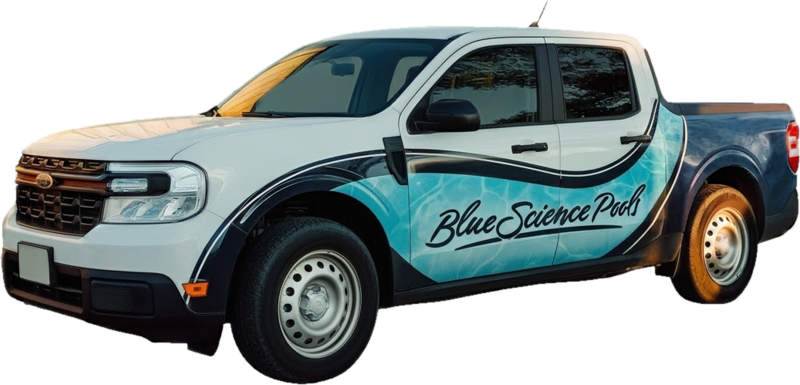
Seen our truck on your street?
That is because we also service West Lake Hills, Barton Creek, Bee Cave, Pflugerville, and Hudson Bend
Know someone there who could use the same pool leak detection? Our Austin team already covers those streets, so a recommendation from you lands with the people who look after your pool.
Pool days in Austin, TX

Blue Science has a long-standing fondness for Austin and for the customers who make caring for pools here so rewarding. The Live Music Capital of the World celebrates Austin's creative spirit everywhere from Lady Bird Lake to the next great encore. A pool adds the best kind of home-field advantage: cool water, familiar chairs, and no hunt for parking. Blue Science supports Austin homes with routine pool service, balanced water, filter maintenance, repairs, leak detection, renovations, and construction planning. Regular observation gives our team a baseline, making unusual water or equipment behavior easier to recognize quickly.