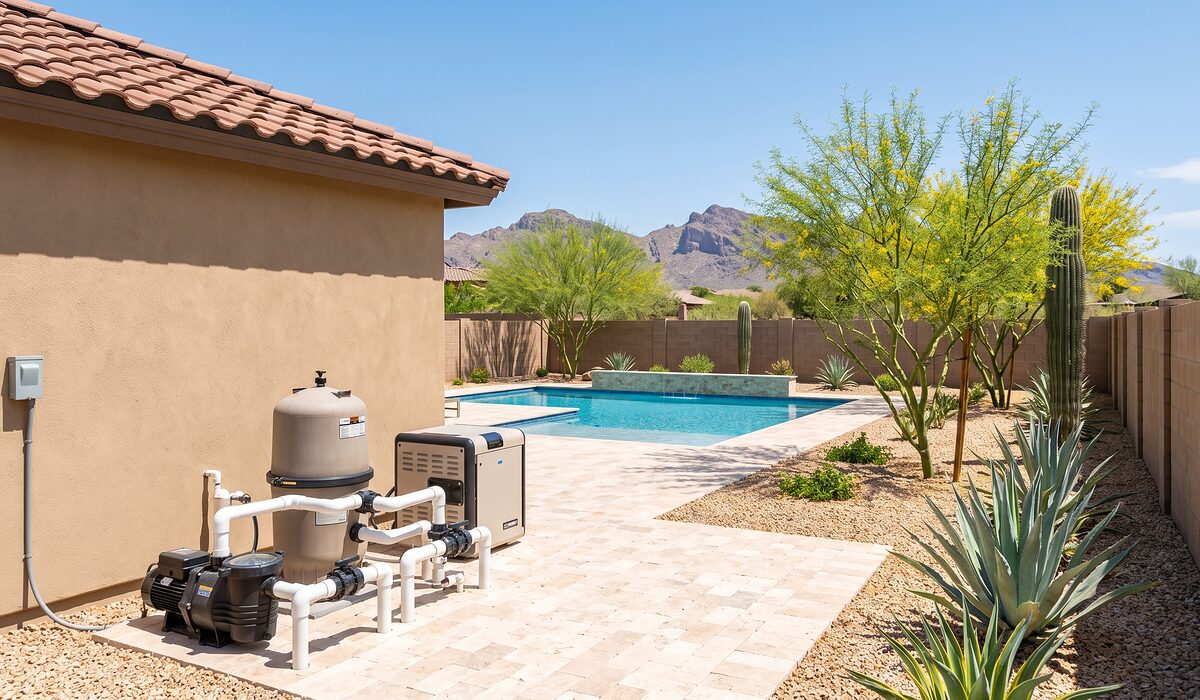
Pool repair in Mesa, AZ from Blue Science: pumps, filters, heaters, salt cells, and automation diagnosed on one $149 visit, quoted in writing before any work, and fixed by the technician who runs your street. Most Mesa pool repair visits are scheduled within the week, and the same trained technicians handle swimming pool equipment year-round, through the hardest water in the country, monsoon dust, and 110-degree heat.
Mesa, AZ Pool Repair
Get clear answers before deciding what to repair
On a Mesa pad we inspect the affected system, identify the likely cause, and explain the practical next step, so the repair decision is yours to make with confidence.
Pool Repair Help for Mesa
A clear repair plan for an unreliable Mesa pool system
Mesa pool equipment fails at both ends of its age range: the Dobson Ranch pads are on their third or fourth set of equipment, and the Eastmark pads are failing in their first warranty cycle, while the water scales heaters and salt cells on both at the same pace. When the pump grinds, the heater locks out, or the cell reads low with a full pool, Blue Science diagnoses the pad and quotes the repair before any work.
On a Dobson Ranch pad the question is repair or replace; on an Eastmark pad it is usually a cheap part on a young pad. We treat the two differently, and on both we read the calcium in the fill water, because a heater replaced without changing the water picture will scale again on the same schedule.
Mesa repair calls: scaled heaters and worn lake-lot pumps
 From the repair truck
Heat exchangers closed by calcium, pump seals and bearings at the end of their life on the 1970s pads, salt cells in Eastmark that quit long before their rated hours, and timers knocked out by monsoon lightning are the calls we take most in Dobson Ranch, Las Sendas, and Eastmark. Dust-scored seals show up every September after the storms.
The diagnosis visit is $149 in Mesa, AZ, and includes a calcium reading on the fill water. Parts, repair labor, replacement equipment, and any special installation requirements are quoted separately in writing.
Repair visits with our Mesa routes
 From the repair truck
Our technicians already run Dobson Ranch, Las Sendas, and Eastmark every week, so a repair visit joins a route that is already on your side of Mesa. Jandy, Pentair, and Hayward parts are on the truck, and most seal, cell, and igniter repairs finish on the first visit.
Owners replacing a worn single-speed pump usually choose a variable-speed model; in a pool that runs eight months a year the electric-bill savings are real, and we quote both.
A repair call in Mesa
How a diagnosis day runs
-
 The call We ask what the pool is doing, when it started, and what is on the pad, so the right parts ride along.
 -
 On the pad Pressure, amperage, and a look at every seal and union before anyone names a part.
 -
 The quote A written repair-or-replace recommendation before work begins, and a time to do it.

How a repair runs
Your Greater Phoenix team
8 cities, one phone number, the same faces
The technician who repairs your pump runs the same routes as the one who cleans the pool next door, so the parts and the know-how are already in Greater Phoenix.

Mesa pool owners love our scientific approach to pool repair, and their reviews say it better than we can. Read them here.
Get Your Pool Working Again
Want clear answers about your Mesa pool?
Tell us what the pool is doing, when it started, and which equipment seems affected, and we will arrange the right diagnostic visit with a technician whose expertise fits the equipment and the hardest water in the country, monsoon dust, and 110-degree heat.

Call Our Pool Experts
520-337-9200 Get a QuoteGood to know
Questions Mesa Pool Owners Ask
Why does my pump trip the breaker on hot afternoons?

Heat. A motor that runs fine at dawn draws more current at 110 degrees, and a tired capacitor or a bearing near the end of its life tips it over. I test the draw on the pad; sometimes the fix is a part, sometimes it is moving the run time to the cooler hours.
Answered by a Blue Science repair technician, Greater PhoenixWhat are the three C's of pool maintenance?
Circulation, cleaning, and chemistry. Circulation is the pump and filter moving every gallon through the filter each day; cleaning is the netting, brushing, and basket-emptying that keeps debris from feeding algae; chemistry is the sanitizer and balance that keep the water safe, the three things the hardest water in the country, monsoon dust, and 110-degree heat attack first. Most repair calls in Mesa trace back to one of the three slipping: a basket left full until the pump runs dry, a filter left dirty until the motor strains, or water so far out of balance that it scales a salt cell or corrodes a heater, which we see in all 8 cities we serve. That is also the order of the diagnosis visit in Mesa: circulation first, then what the hardest water in the country, monsoon dust, and 110-degree heat have been doing to the pad, then the failed part.
What are common pool problems?
In Mesa, under the hardest water in the country, monsoon dust, and 110-degree heat, the calls come in a pattern: a pump that has lost prime or runs loud, a filter with pressure climbing every week, a heater that will not fire, a salt system reporting low salt, cloudy or green water that chemicals alone will not fix, and a water level that keeps dropping. Most trace back to the hardest water in the country, monsoon dust, and 110-degree heat working on the pad and the water, the same six problems across all 8 cities we serve. A Mesa pump that is loud but still moving water is usually a bearing rather than a motor; the visit tells which, and the hardest water in the country, monsoon dust, and 110-degree heat make it a common call.
What causes most pool repairs?
Neglected circulation, cleaning, or chemistry, then the weather, meaning the hardest water in the country, monsoon dust, and 110-degree heat. A Mesa pump run dry against a packed basket, a filter left at high pressure, or water that scaled the heater exchanger accounts for most calls, and the equipment that goes first here is salt cells and heater exchangers scaled by hard water, followed by pump seals scored by dust and motors worn out running long summer hours; fewer repairs come from bad parts than from the conditions they ran in, across every one of our 8 cities. In Mesa we quote the repair in writing and note on the report what to change so it does not repeat, in all 8 cities we serve.
What should I do to protect my equipment before a monsoon dust storm?
In Mesa, keep the pump running so the filter can catch the grit, empty the skimmer and pump baskets as soon as it passes, and expect to brush and add chlorine sooner than the schedule says. A dust storm can turn a clear pool cloudy in an hour and load a filter in a day; a pump left to strain against a packed basket is the most common storm-week repair. If you are not sure what your pad needs, call 520-337-9200 before the weather arrives rather than after, and remember that the hardest water in the country, monsoon dust, and 110-degree heat leave the pad more exposed than it looks.
Why does my salt system say low salt when the water tests fine?
The cell is usually the problem, not the salt, and the hardest water in the country, monsoon dust, and 110-degree heat scale it faster. Scale builds on the plates in hard or unbalanced water and the cell reads it as low conductivity, and cells also lose output as they age; a Mesa repair visit tests the salt directly, inspects and cleans the cell, and tells you whether it is scale, a sensor, or a cell at the end of its life, as in every one of the 8 cities we serve.

Seen our truck on your street?
That is because we also service Gilbert, Chandler, Scottsdale, Glendale, and Peoria
The route that covers Mesa runs through these towns on the same days, with the same technicians. If you split time between houses, or your parents' pool is a few exits away, one phone number covers all of them.