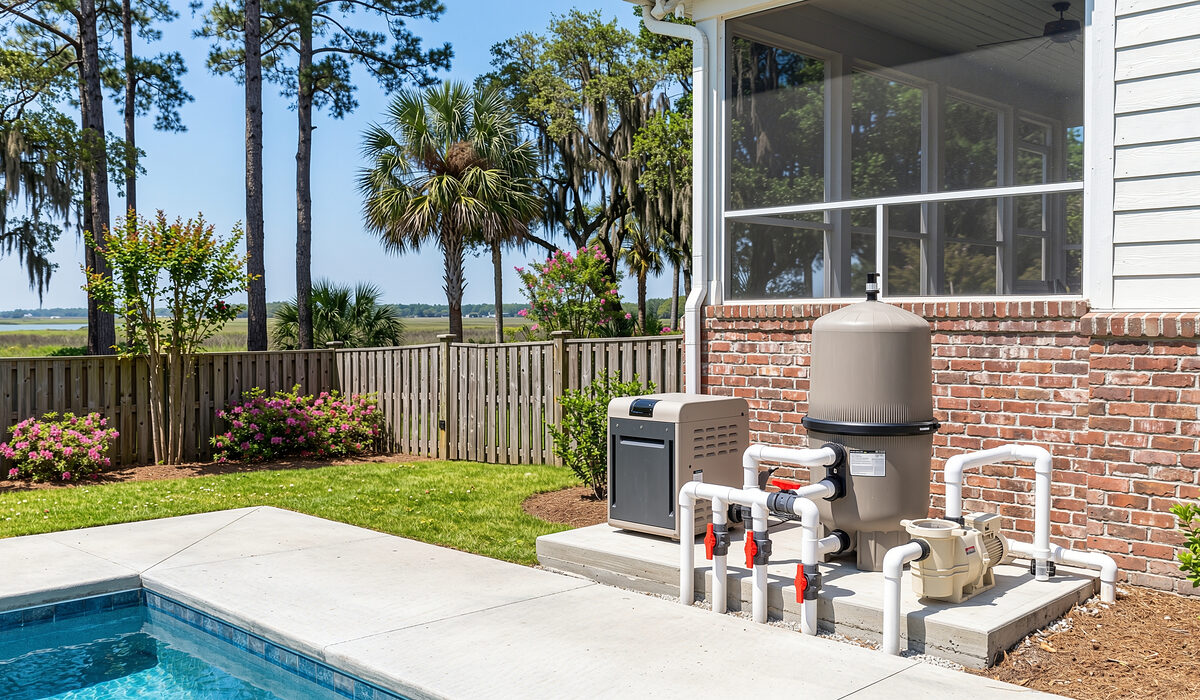
Pool repair in Pooler, GA from Blue Science: pumps, filters, heaters, salt cells, and automation diagnosed on one $149 visit, quoted in writing before any work, and fixed by the technician who runs your street. In Pooler most pool repair visits are scheduled within the week; the same trained technicians handle swimming pool equipment year-round and know what live oak litter, salt air, and afternoon storms do to a pad.
Pooler, GA Pool Repair
Get clear answers before deciding what to repair
On a Pooler pad we inspect the affected system, identify the likely cause, and explain the practical next step, so the repair decision is yours to make with confidence.
Pool Repair Help for Pooler
Turn an unreliable pool system into a clear repair plan
Pooler equipment is young, and young equipment fails in specific ways: salt cells and heat exchangers scaled by hard water long before their rated hours, variable-speed pumps and automation boards taken out by summer lightning, and seals scored by sand after storms. When the cell reads low, the controller goes dark, or the pump will not prime, Blue Science diagnoses the pad and quotes the repair before any work.
A three-year-old pad with a dead board is usually a surge story, and a scaled cell at half its life is a water story; neither is a defective part. We test the bonding and read the water during the diagnosis so the quote fixes the cause and the replacement lasts.
Pooler repair calls: scaled cells, dead boards, and sand
 From the repair truck
Salt cells and exchangers scaled by hard water, automation boards knocked out by summer lightning, pump seals scored by sand after a storm, and heaters that will not light for the first cool evening are the calls we take most in Savannah Quarters, Godley Station, and Forest Lakes. We start every repair call at the equipment pad as a whole; a closed valve or a low water level can look exactly like a failed part.
In Pooler the diagnosis visit is $149; parts, labor, replacement equipment, and special installation requirements are priced separately and put in writing before any work.
Repair visits with our Pooler routes
 From the repair truck
Our technicians already run Savannah Quarters, Godley Station, Forest Lakes, and Westbrook every week, so a repair visit joins a route that is already in your subdivision. Jandy, Pentair, and Hayward parts ride on every truck, and the usual seal, capacitor, and igniter repairs are finished on the spot.
On a weekly plan the photo report is where problems show first, so the repair that follows is usually the small one.
A repair call in Pooler
How a diagnosis day runs
-
 The call We ask what the pool is doing, when it started, and what is on the pad, so the right parts ride along.
 -
 On the pad Pressure, amperage, and a look at every seal and union before anyone names a part.
 -
 The quote A written repair-or-replace recommendation before work begins, and a time to do it.

How a repair runs
Your Greater Savannah team
9 cities, one phone number, the same faces
The technician who repairs your pump runs the same routes as the one who cleans the pool next door, so the parts and the know-how are already in Greater Savannah.

Get Your Pool Working Again
Ready for clear answers about your Pooler pool?
Tell us what the pool is doing, when the problem started, and which equipment appears affected. We will help you arrange the appropriate diagnostic visit with a technician whose expertise fits the equipment.

Call Our Pool Experts
912-520-4700 Get a QuoteGood to know
Questions Pooler Pool Owners Ask
Why did my pump fail right after the cold snap?

Ice. Water left standing in the pump housing froze, expanded, and cracked the casing or the seal plate, and the leak showed up when it thawed. In Georgia that is the most common January repair I see, and it is avoidable: run the pump through the freeze nights so the water keeps moving, and switch on freeze protection where the automation has it.
Answered by a Blue Science repair technician, Greater SavannahWhat are the three C's of pool maintenance?
Circulation, cleaning, and chemistry. Circulation is the pump and filter moving every gallon through the filter each day; cleaning is the netting, brushing, and basket-emptying that keeps debris from feeding algae; chemistry is the sanitizer and balance that keep the water safe, the three things live oak litter, salt air, and afternoon storms attack first. Most repair calls in Pooler trace back to one of the three slipping: a basket left full until the pump runs dry, a filter left dirty until the motor strains, or water so far out of balance that it scales a salt cell or corrodes a heater, which we see in all 9 cities we serve. In Pooler that is why our repair technicians ride the same routes as our weekly service across 9 cities: the fix and the prevention come from the same truck.
What are common pool problems?
The common ones are circulation problems (a pump that will not prime, air in the basket, weak flow), filtration problems (pressure that climbs fast, a cartridge that will not rinse clean), heater and salt cell failures, automation and timer faults after storms, and water loss, and live oak litter, salt air, and afternoon storms bring each of them on. In Pooler, with those conditions at work, the usual first failures are pump motors and seals worn by long summer hours and pollen-loaded filters, followed by timers and control boards hit by summer lightning and pump housings cracked by a January freeze. Our Pooler technicians see the same pattern every season under live oak litter, salt air, and afternoon storms, which is why the diagnosis visit checks the whole system first.
What causes most pool repairs?
Neglected circulation, cleaning, or chemistry, then the weather, meaning live oak litter, salt air, and afternoon storms. A Pooler pump run dry against a packed basket, a filter left at high pressure, or water that scaled the heater exchanger accounts for most calls, and the equipment that goes first here is pump motors and seals worn by long summer hours and pollen-loaded filters, followed by timers and control boards hit by summer lightning and pump housings cracked by a January freeze; fewer repairs come from bad parts than from the conditions they ran in, across every one of our 9 cities. In Pooler we quote the repair in writing and note on the report what to change so it does not repeat, in all 9 cities we serve.
Is it worth fixing a heater in Georgia?
If you use the pool in the shoulder months, yes, and live oak litter, salt air, and afternoon storms decide how long those months are. A heater extends the Pooler swim season by weeks on each end, and most heater calls are an ignitor, a sensor, a pressure switch, or a corroded connection rather than the exchanger itself; when the exchanger has gone, we say so, because that is the point where replacement wins, and 912-520-4700 gets you the numbers.
Why does my filter pressure climb so fast?
Because of what Pooler puts in the water: live oak leaf drop and Spanish moss all year, pine pollen in spring, salt air off the marsh and the rivers, humid summers with afternoon thunderstorms and a swim season that runs from April into October, hard aquifer water that scales the tile line, sandy soil that lets decks shift, and a hurricane season that ends in November. A cartridge or DE filter loads up faster here than the manual suggests, and running it dirty strains the pump and starves the returns; rising pressure between cleanings is the sign to schedule a filter service, not to backwash harder, a rule that holds in all 9 cities we serve.

Seen our truck on your street?
That is because we also service Port Wentworth, Garden City, Georgetown, Rincon, and Richmond Hill
Our Pooler routes do not stop at the city limit. The same pool equipment repair runs in each of these towns, and the schedule is built so a technician working Pooler is a short drive from any of them.